The Best Time to Take Moringa Powder

Moringa oleifera, the drumstick tree, has been part of Indian kitchens and Ayurvedic practice for centuries. The leaves are dried and milled into a fine green powder that carries plant protein, iron, calcium, vitamin C, and a generous spread of antioxidants. Most people buy it, stir a teaspoon into water, and hope for the best. That works, but it leaves a lot on the table.
The question we get asked most often is simple: when should I actually take it? The honest answer is that there is no single magic hour. There is, however, a right time for your goal and your routine. This guide walks through how timing changes what moringa does for you, the dosage that makes sense for most adults, and how to fit a daily teaspoon into an ordinary Indian day without it becoming a chore.
Why Timing Matters at All
Moringa is not a stimulant and it is not a sedative. It will not keep you awake the way coffee does, nor will it knock you out. What it does is supply a steady load of micronutrients and plant compounds. The timing decision is less about avoiding side effects and more about matching the powder to what your body is doing at that hour, and about consistency, which is the single biggest factor in whether you notice anything at all.
Three things shift with timing. First, absorption: some nutrients in moringa, like iron and certain antioxidants, behave differently on an empty stomach versus alongside food. Second, energy: many people find the powder gives a gentle, even lift, which is welcome in the morning but less useful at midnight. Third, digestion: moringa carries fibre, and a large dose on a completely empty, sensitive stomach can feel heavy for some people. Get these three right and the powder simply works better.
Morning: The Default Choice for Most People
For the majority of users, morning is the best time to take moringa powder. Taken early, it sets a nutrient baseline for the day and pairs naturally with the gentle, sustained energy people report. There is no caffeine crash because there is no caffeine, just a calm sense of being fuelled.
You have two reasonable morning windows. The first is on a light or empty stomach, 20 to 30 minutes before breakfast, with warm water. This suits people who want the cleanest absorption and tolerate the powder well. The second is with breakfast, stirred into a smoothie, curd, or a glass of buttermilk. Taking it with food is the gentler option and the better one if your stomach is at all sensitive in the early hours.
Tip: If you want better iron uptake from moringa, pair it with a source of vitamin C. A squeeze of lemon in your morning water, or a few slices of amla or orange alongside, helps your body absorb plant iron more efficiently than moringa taken on its own.
Midday: Steady Through the Afternoon Slump
If mornings are too rushed for one more step, a pre-lunch or with-lunch dose is a strong alternative. The 3 to 5 pm slump is real for most working adults, and a midday teaspoon, taken with or just before lunch, can support steadier energy into the afternoon without the jitter-and-crash cycle of a second cup of coffee or chai.
Taking moringa with a meal also blunts any chance of stomach heaviness, because the food slows things down and gives the fibre something to travel with. For people who skip breakfast, this is often the most realistic time to be consistent, and consistency beats theoretical optimal timing every single day.
Evening and Night: Use With Care
Moringa is not a sleep aid, but it is generally fine in the evening for people who do not feel energised by it. If a daytime dose leaves you feeling a little too alert, simply move it earlier. There is no need to take it late, and no special night-time benefit that morning or midday does not already cover.
One practical note: a large dose right before bed, on an empty stomach, can sit heavily for some people because of the fibre. If you do prefer an evening dose, keep it on the lower side and take it with your dinner rather than long after it.
The best time to take moringa is the time you will actually remember every day. Consistency does more than perfect timing ever will.
How Much, and How to Build Up
For most healthy adults, a daily dose of 3 to 5 grams of moringa powder, roughly one level teaspoon, is a sensible amount. That is enough to deliver a meaningful nutrient contribution without overdoing the fibre or the strong, earthy taste.
If you are new to moringa, start low and let your system adjust over a week or two before settling into your full daily teaspoon.
- 1Days 1 to 4: Start with half a teaspoon (about 1.5 to 2 g) once a day, with food.
- 2Days 5 to 10: Move to a full level teaspoon (about 3 g), once a day.
- 3Day 11 onwards: Hold at 3 to 5 g daily, at your chosen time. Some people split this into two smaller doses, morning and midday.
- 4Stay at a dose that feels comfortable. There is no benefit to large amounts; more powder is not more wellness.
If you are pregnant, nursing, taking prescription medication (especially for blood sugar, blood pressure, or thyroid), or managing an ongoing health condition, talk to your physician or a qualified Ayurvedic practitioner before adding moringa to your routine. This guide is for general wellness support, not medical advice.
Empty Stomach or With Food?
Both work, and the right choice depends on you rather than on a universal rule. Here is the simple way to decide.
- Take it on an empty stomach if you tolerate it well and want the most direct absorption. Use warm water and wait 20 to 30 minutes before eating.
- Take it with food if your stomach is sensitive, if you have had any heaviness or mild nausea on an empty stomach, or if you simply find it easier to remember at mealtimes.
- When in doubt, start with food. It is the gentler default and you can always shift to an empty stomach later once you know how your body responds.
Easy Ways to Take It Every Day
Moringa has a green, slightly grassy, faintly bitter taste. Some people enjoy it; others want it hidden. The trick to staying consistent is finding a delivery method you do not dread. A few that work well in an Indian kitchen:
- Warm water with lemon: the simplest morning option, and the lemon helps with iron absorption.
- Buttermilk or chaas: a teaspoon stirred in, ideally with a pinch of roasted cumin and salt, masks the bitterness nicely.
- Smoothies: banana, curd, and a teaspoon of moringa make a balanced breakfast that hides the flavour almost completely.
- Dal, sabzi, or soup: stir the powder in at the end of cooking, off the heat, so you keep more of the heat-sensitive nutrients.
- Curd or raita: fold it into thick curd with a little honey for a quick, cooling option.
Avoid boiling moringa powder hard or adding it to food that is still bubbling on the flame. High, prolonged heat degrades some of the vitamin C and antioxidant content. Stirring it into warm rather than boiling preparations keeps more of what you paid for intact.
Quality Changes Everything
Timing and dosage only matter if the powder itself is good. Moringa loses colour and potency when it is over-dried, stored badly, or milled from older, lower-grade leaves. A quality powder is a vivid, deep green, smells fresh and green rather than musty or like hay, and tastes clean rather than dusty.
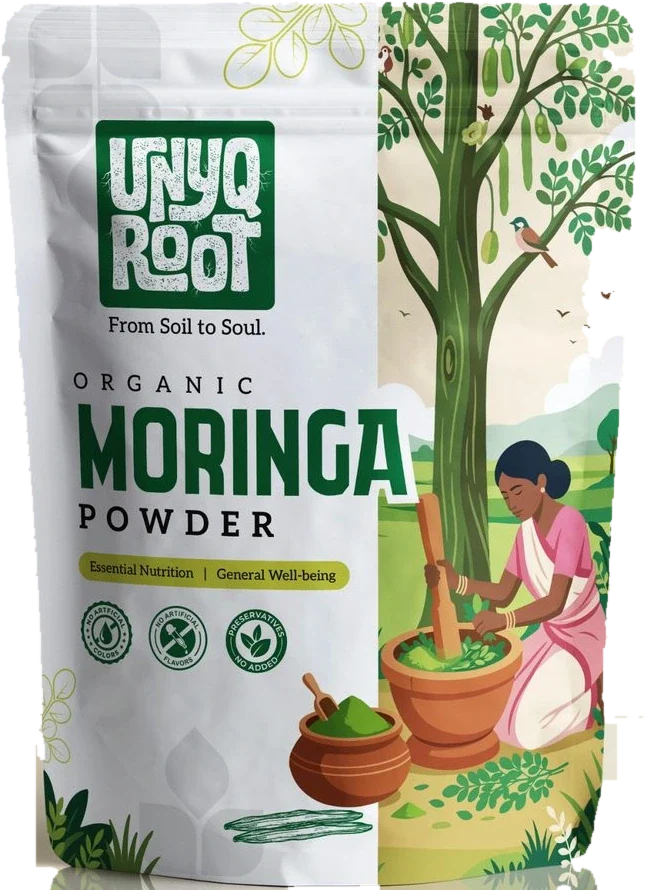
UNYQROOT moringa is made from leaves that are shade-dried to protect their colour and nutrients, then milled fine and sealed. That care is the reason a single teaspoon goes further. If your moringa is dull, brownish, or flavourless, no amount of clever timing will fix it. Start with a powder you trust, then layer the timing on top.
A Simple Daily Template
If you want to stop overthinking it, here is a routine that suits most people and is easy to keep up:
- 1Morning, with or just before breakfast: one level teaspoon (3 g) of UNYQROOT moringa in warm water with a squeeze of lemon, or stirred into curd or a smoothie.
- 2Optional midday top-up: if you tend to fade in the afternoon, add a small half-teaspoon with lunch instead of reaching for a third tea.
- 3Keep the jar somewhere you cannot miss it, next to the kettle or the curd, so the habit anchors to something you already do daily.
- 4Give it four to six weeks of consistent use before judging how you feel. Subtle support builds gradually, not overnight.
That is the whole method. Pick a time that fits your real day, take a sensible 3 to 5 g, pair it with vitamin C when you can, keep the heat low, and stay consistent. The best time to take moringa powder is ultimately the one you will keep coming back to, morning after morning, from soil to soul.
Bring Moringa into your routine
View productFrequently asked
For most people, morning is best, either on a light stomach 20 to 30 minutes before breakfast or stirred into breakfast itself. It pairs well with the gentle, even energy many users report. If mornings are rushed, a pre-lunch or with-lunch dose works just as well.